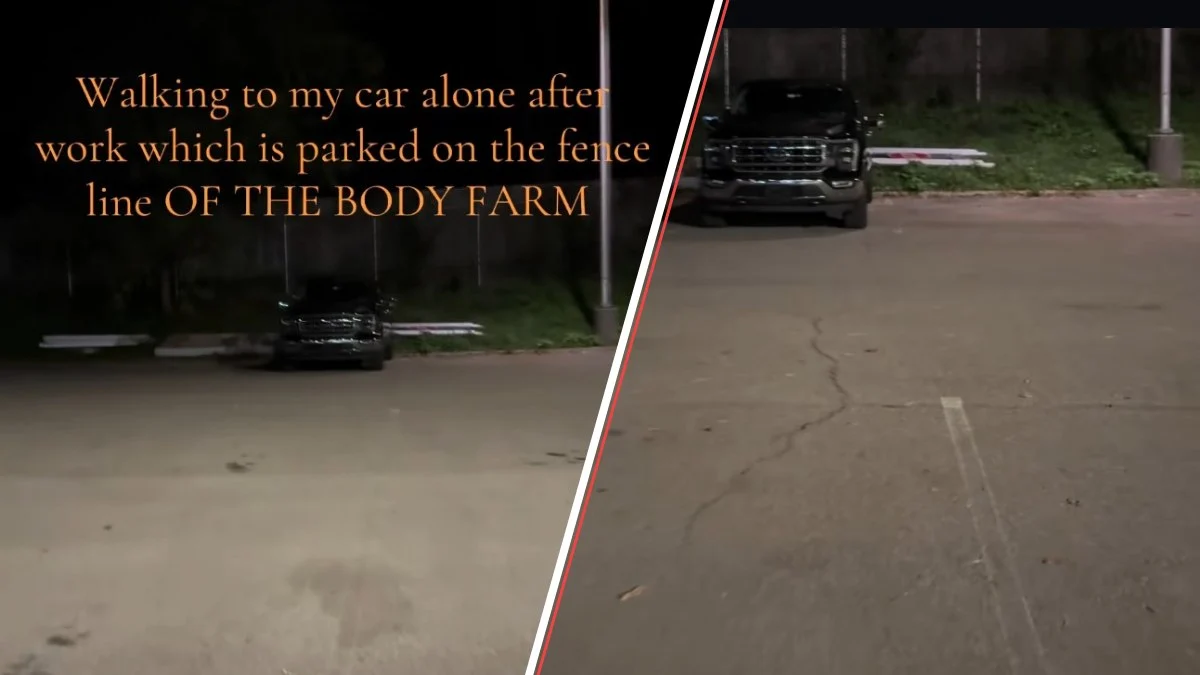
A nurse has gone viral for showing the walk to her car after work, which is parked at the fence line of a body farm. The nine-second video was posted on TikTok by Michaela (@michaelameier8) on Nov. 4 and has more than 185,000 likes. She tagged it with #nurse, #ernurse and #scary.
Text on the screen says she is walking to her car alone after work, and her caption jokes about the downside of being a “mid shifter.” She says there is never any parking when she arrives, and when she leaves it is just her and an empty lot.
The clip has drawn more than 1,000 comments, and the most-liked one, with about 22,000 likes, simply asks what a body farm is. The video does not name her hospital or the facility, but the best-known body farm is the one run by the University of Tennessee in Knoxville, so here is what that place actually is.
What is a body farm?
A body farm is an outdoor research site where donated human bodies are left to decompose naturally, so scientists can study what happens over time. The University of Tennessee’s Anthropology Research Facility is widely described as the original, and the university’s Forensic Anthropology Center says anthropologist William Bass opened it at its current location in 1980.
The center says the site covers about three acres of wooded land. Researchers use it to study the stages of decomposition and to estimate how long a person has been dead, which helps law enforcement and medical examiners identify remains and work out what happened.
Scientists track the process in stages, from the fresh and bloat stages to decay and dry remains, and they also look at how insects, weather and the environment change the timeline. That information gives investigators a better way to estimate time of death in real cases.
Once the bodies have decomposed, the bones are cleaned, measured and added to a skeletal collection. That collection now holds more than 2,500 individuals, according to the center.
Many viewers had the same question as the top commenter. Several asked what a body farm is, and one joked that she is “too Australian to know what the body farm is.” Another was stunned that such a place is real.
The other big question was about the smell. A comment asking whether it smells bad in that area has around 1,600 likes, and a few more viewers asked the same thing in their own words.
A reply with about 3,000 likes took a calmer view, pointing out that it is just bodies at night and that they are not going to “come running after you.” The nurse’s video shows only a dark parking lot and a fence in the distance, so it is hard to say how close her car really is to the site.
Can you visit or donate to a body farm?
Visiting is not an option. The Tennessee center says it does not host tours or visitors, and access to the research facility is limited. That did not stop the most-liked reactions from viewers who said they wanted to go, including one comment with more than 9,000 likes that calls the place interesting.
Donating is possible, however, and people can register in advance through the center. It says it does not charge for body donation, although some costs, such as funeral home charges tied to the death certificate, can fall to the family.
Some commenters said they would consider it. One, with about 3,000 likes, wrote that donating would help science and give them the chance to return to nature, while another said their father had donated his body to the University of Tennessee so that others could learn from it.
There are rules, too. Bodies cannot be embalmed, and people who die with certain infections, including HIV and hepatitis, cannot be accepted.
Tennessee is not the only state with one. Several other universities run similar facilities, including Western Carolina University in North Carolina and Texas State University in San Marcos.
For the nurse, it is simply where the lot ends and the shift begins. It is a reminder that a work commute can come with some unusual neighbors.