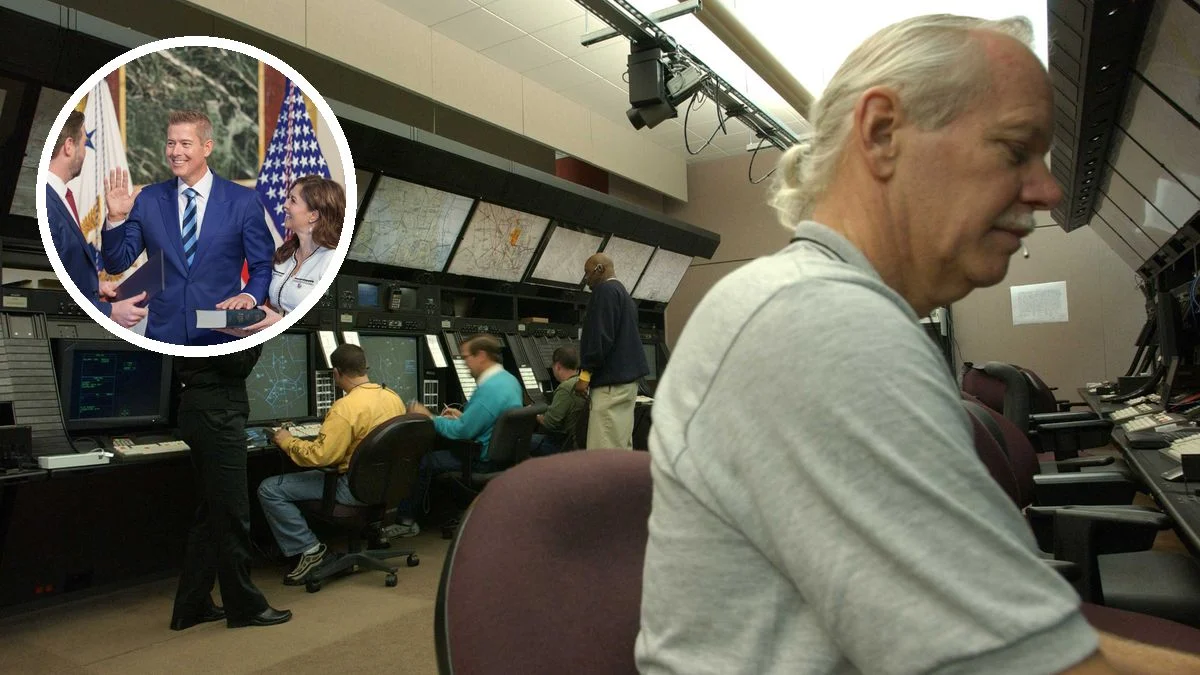
Transportation Secretary Sean Duffy said on “Face the Nation” on Sunday that the FAA is investigating a second site, a radar facility in Amarillo, Texas, in addition to the El Dorado, Arkansas, router tied to Friday’s nationwide ground stop. He said the Amarillo work was finished weeks ago and that the FAA does not yet know why it became a problem on Friday.
Both routers are now with L3Harris, the contractor that owns and operates the network. The FAA is on site and the FBI is offering support, Duffy told Margaret Brennan. “I’m going to tell you and the American people what we find,” he said. He expected flights to be back at full capacity by the end of Sunday or on Monday. Our earlier report covers what Duffy said on Saturday.
Duffy also answered the controllers’ union, PASS, which said the problem was confined to two contractor-owned routers updated in the middle of the day without its technicians. He said the union works only on FAA-owned equipment such as radios and radar, and that telecom is L3Harris’s network. Midday work at a remote site is normal, he said, because it had been done thousands of times without trouble. Big hubs like Newark, Atlanta and Los Angeles get this kind of work at night. “We’re going to have to reevaluate now when we do this work,” he said.
How far along is the copper-to-fiber swap?
Brennan asked about a September report from the Government Accountability Office, and the report itself has numbers that put Friday in context. GAO-26-107992, released September 14, looked at the FAA’s modernization program and noted that, as of May 2026, the FAA reported replacing 2,560 of 5,170 old copper wires with fiber optic cable. That is 49.5%, or 2,610 wires still to go, by our calculation from those figures.
| Copper wires replaced (May 2026, as FAA reported) | 2,560 of 5,170 |
| Separate project schedules | 11,389, not integrated |
| Funding Congress appropriated | $12.5 billion (July 2025) |
| Phase 1 completion target | December 2028 |
| Phase 2 estimate (FAA, excludes facilities) | about $10.2 billion |
GAO also said the FAA has no master schedule for phase 1. Instead there are 11,389 individual project schedules, so projects can be set for the same site without being planned to reduce the effect on controllers. The agency has no full lifecycle cost estimate either. The Transportation Department partially agreed with both recommendations, and GAO lists them as open. The report does not mention Friday’s outage, which came two months later.
Is it the old wire or the new gear?
Duffy said the El Dorado copper was being discontinued by the telecom provider, which forced the switch. The BBC reported that the new router sent a flood of traffic that left 17 of 22 route centers with unstable voice and ground communications, and that it took the FAA 45 minutes to find the source because maintenance is logged on paper. L3Harris said on Saturday it had finished more than 70% of its assigned modernization work and was supporting the investigation.
Duffy has said the cause could be the installation or the router itself. The BBC reported he said officials would work out whether it was “incompetence” by the contractor or faulty equipment, and that he has pressed Congress for more money: he has put the overhaul at $50 billion, and President Trump has requested $30.1 billion. L3Harris’s 70% figure and GAO’s 49.5% measure different things, so they should not be compared directly. Neither the FAA nor L3Harris has said what happened at Amarillo.